
CloudRider
CloudRider
The path-layer probe for broadcast and media
A live video doesn't fail politely. A stream stalls at close. A CDN router drops frames in the middle of a marquee event. And every dashboard on the wall reports "healthy". CloudRider travels the same path as your video and identifies the failing segment in seconds, before audiences notice.
THE PRODUCT
Built for the way video fails
CloudRider is AlvaLinks’s path-layer probe for broadcast and media. Broadcast fails mid-stream, in front of large audiences, across a delivery path shared with providers you do not control.
CloudRider sends synthetic packets shaped like your production video (matching the 5-tuple, size, and headers) down the same path your stream takes. When that path degrades, the impairment surfaces per packet and per second, whether it originates on your access link, the open internet, in a cloud region, or at a single hop.
It is tuned for the transports broadcast runs on: SRT, RIST, Zixi, and NDI.
What it does on a live path
Root cause, not symptom
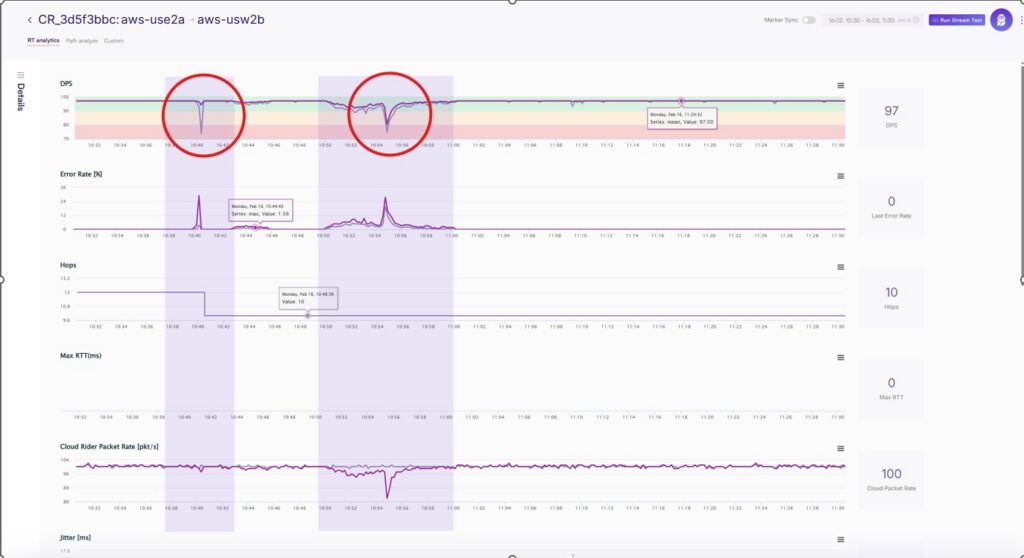
CloudRider connects visual and transport events to the network conditions beneath them. Broadcast and IT teams run genuine root-cause analysis rather than commissioning consultants to reconstruct the incident after the fact.
Rogue flow detection
Every flow sharing a micro agent’s link can introduce packet loss, jitter, and RTT delay. CloudRider gathers data on all detected flows, inbound and outbound, giving IT the full picture needed to manage forwarding, filtering, and TOS.
Cloud path visibility
Running video through AWS MediaConnect and DirectConnect is a serious bet, and native observability for it is thin. CloudRider gives you real-time, deep-path visibility into that route without disrupting the service.
A and B path prioritization
Most serious deployments run redundant A and B paths. CloudRider measures packet loss, latency, hop count, and jitter on both, so you know which path to trust and why. Service holds steady through a switch.
SLA you can prove
Providers rarely furnish an aggregated view of delivered performance. CloudRider supplies the packet loss, hop, and jitter data required to hold an SLA account and track it over time.
THE SUITE
Six tools on one probe
StreamTest
Bidirectional link evaluation and testing. Qualify the network before placing a service on it by measuring packet loss, RTT, latency, and jitter at multiple bitrates or with a fixed-rate pattern.
StreamRide
High-accuracy test-stream and link information gathering.
StreamPath
Path discovery and analysis. CloudRider re-tests the live path every second, so a route change surfaces as it happens.
FlowMonitor
Data on every flow detected on a micro agent.
BufferEmulation
Converts the probing data into a decision: the minimal optimal latency buffer for SRT, RIST, Zixi, or NDI.
ScopeView
Packet-arrival visualization with long-term, cloud-stored analytics for historical investigation.
Integrates with your operation
Extended alarms. Multi-level, direct or multi-user, wired into Email and Slack.
REST API. Connect CloudRider to any third-party platform or orchestration system.
Long-term retention. All data and analysis are stored in a cloud database for extended investigation.
Questions broadcast teams ask first
-
1. What is a path-layer probe?
A path-layer probe sends synthetic packets that carry the same signature as the application's traffic and travel the same network path. It detects impairments per packet, in real time, and localizes them to the segment or hop where they occur.
-
2. Which transport protocols does CloudRider support?
CloudRider is tuned for the transports broadcast runs on: SRT, RIST, Zixi, and NDI.
-
3. Does CloudRider disrupt the live stream?
No. CloudRider's synthetic packets ride along the production video path without touching it, and probing runs continuously during live events.
-
4. How is CloudRider different from stream analyzers and probe hardware?
Stream analyzers inspect the video itself; CloudRider detects what the network does to it, per packet and per hop. It is software only, deploys on standard hosts, and connects visual and transport events to the network conditions beneath them.
See CloudRider on your network
Bring your worst delivery path. Our product team will show you what CloudRider sees on it.